
The capabilities of specialized writing tools, built to work as one.
OpusWriter brings serious tools for story development, writing, editing, publishing, and managing your entire series into one shared environment.
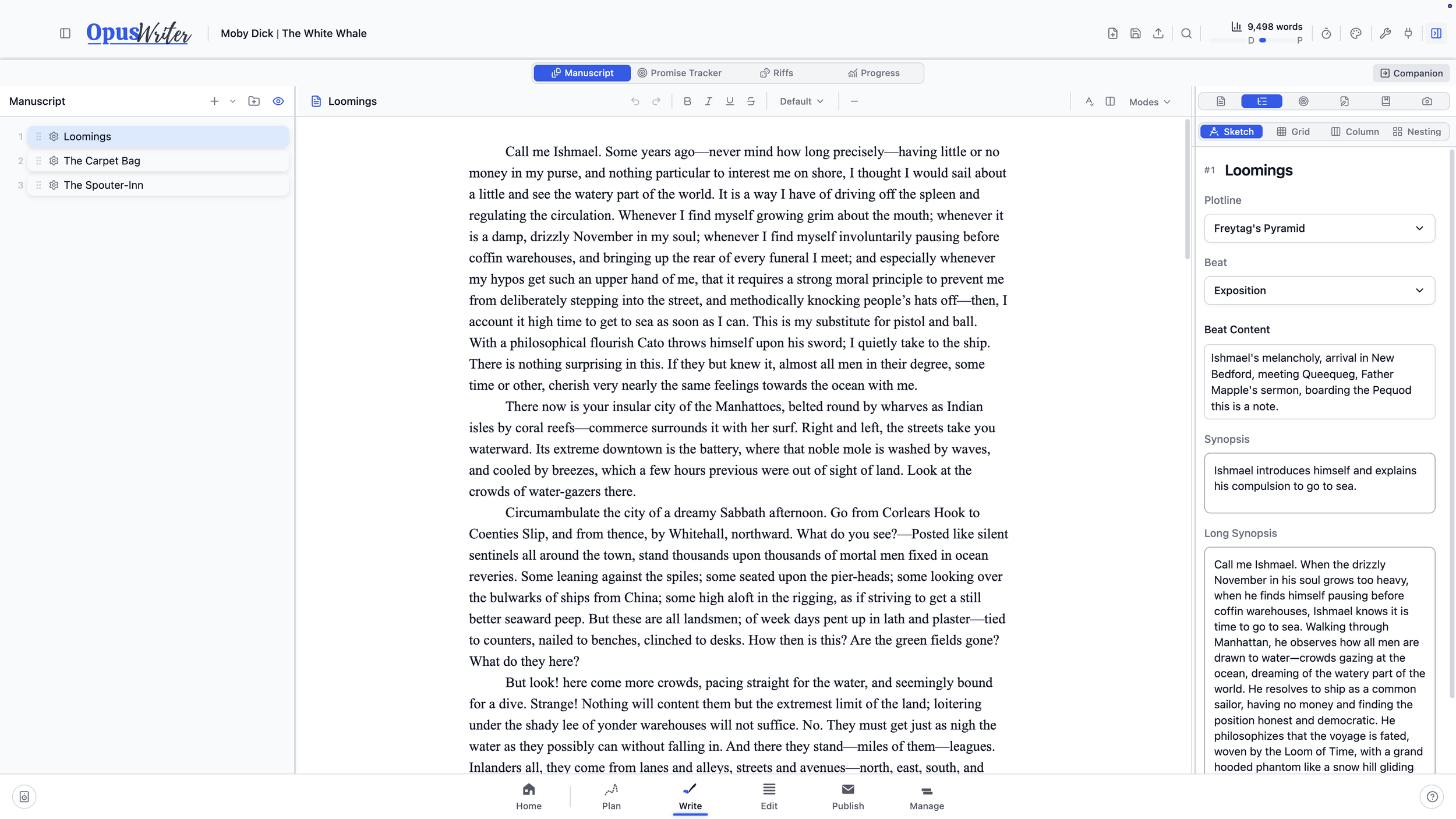
This goes beyond a bunch of familiar writing apps bolted together.
This is Project Management for fiction.
Here are just a few of the possibilities when everything is connected.
While each workspace is built for its own job, they’re all part of a shared ecosystem.
-

Welcome to Home, the center of your writing life. Here you capture those early ideas before you know where they belong, then, with the click of a button, send them into the right book when you do.
See the combined progress across every book and project, gain insight into when you work best, and keep the goals, deadlines, and measures that matter to you in view.
Learn more about Home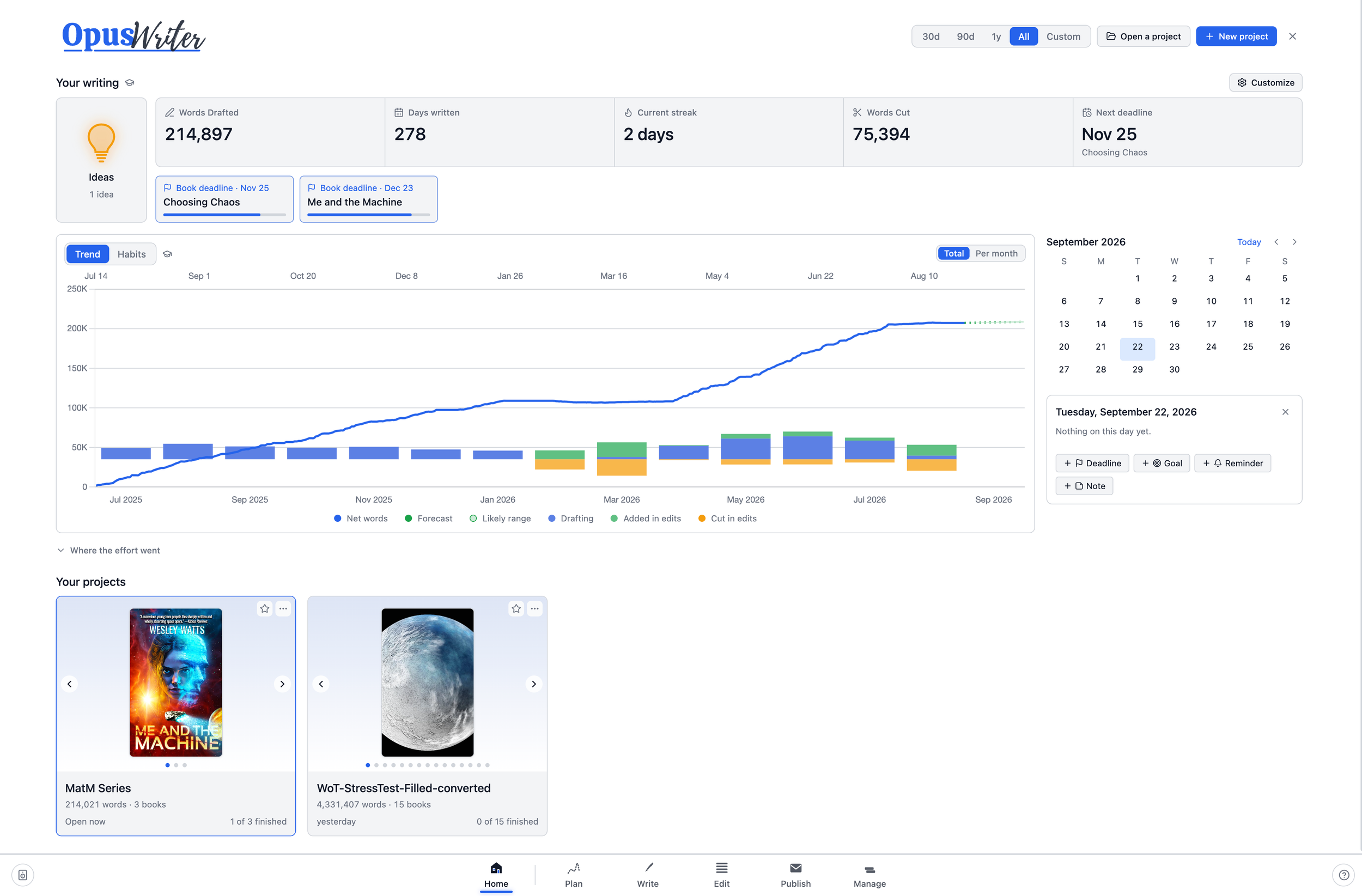
-

There are nearly as many ways to plot a book as there are writers, and Plan was built to accommodate that fact. Plot as much or as little as your process needs, choosing from multiple outlining methods, dozens and dozens of beat sheets, character and setting tools, timelines, and an interconnected Board.
Or use the built-in Plugin Creator to make your own tools. None of this happens in isolation. Choices you make here spiderweb through the rest of your project.
Learn more about Plan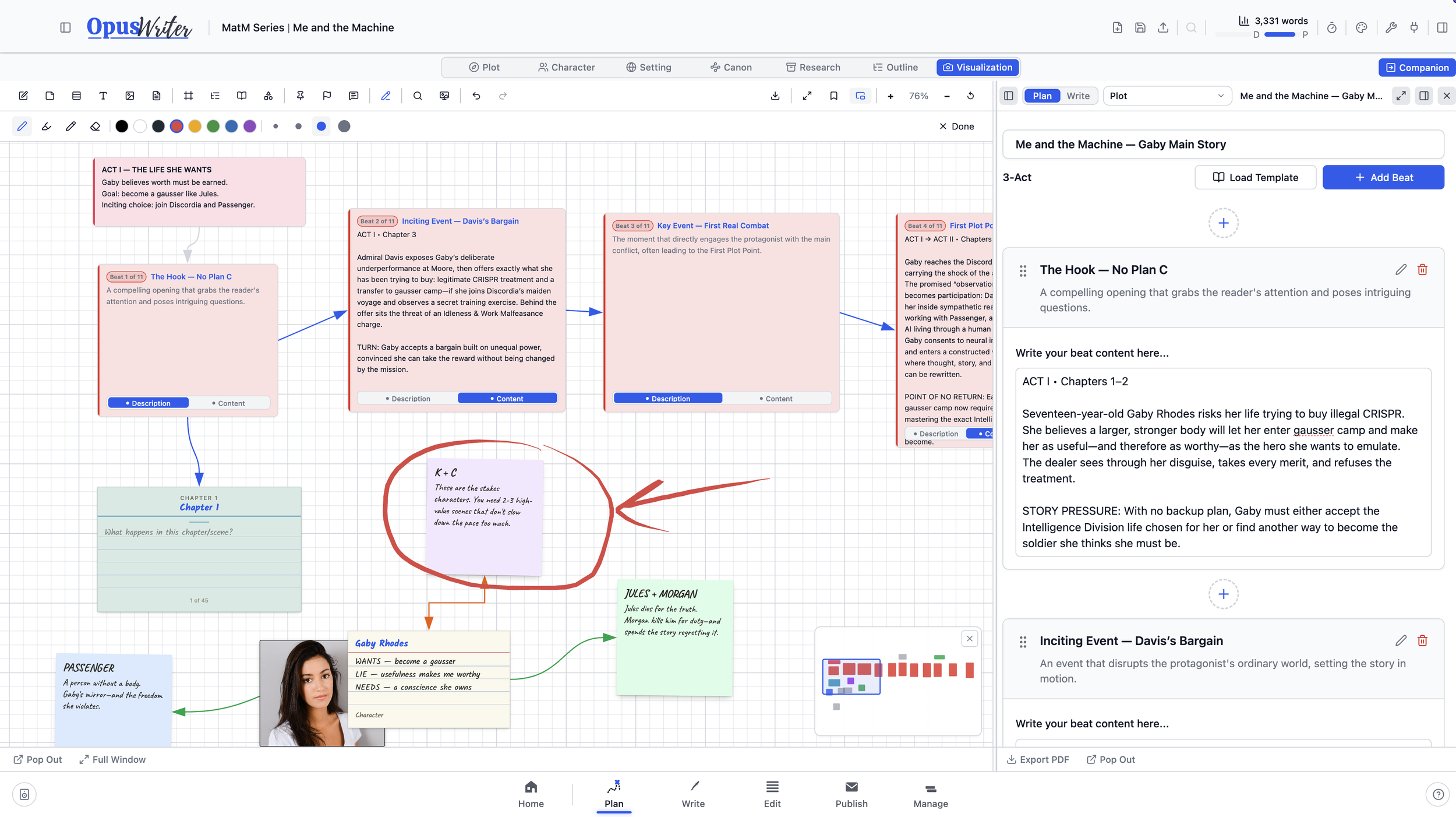
-

Write is a focused drafting space for both careful plotters and writers who discover the story as they go. If you wrote an outline in Plan, it’s here next to your manuscript, still fully editable.
Write also brings unique tools to track promises you’ve made to the reader and record changes that affect scenes you’ve already written.
Learn more about Write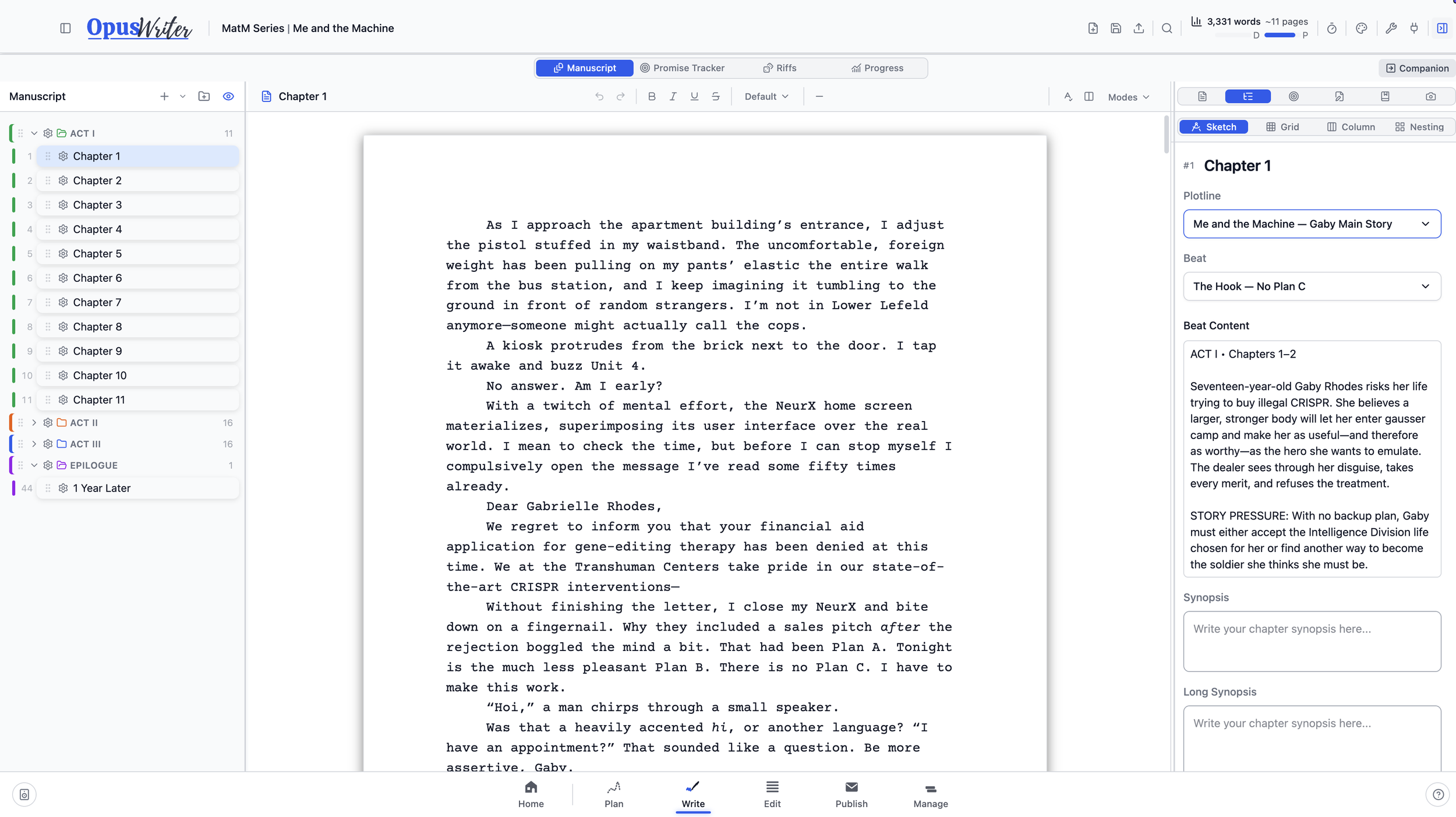
-

Did you set your intended tension for each scene back when you were outlining in Plan? If you did, Edit is analyzing your prose and giving you a read on whether you hit that target.
That’s just one of over 50 prose-analysis tools. They cover everything you’d expect, like highlighting adverbs and filtering language, then go beyond that with recognition of common rhetorical devices.
And when you want to work with an editor (they basically all work in Word), you can round-trip their document so Comments and Track Changes return to OpusWriter without splitting your book between two systems.
Learn more about Edit
-
Publish turns the manuscript you’re already writing into a paperback, hardcover, ebook, submission manuscript, or audiobook script. The Styles you set in your manuscript while drafting in Write carry through here, where you can fine-tune how they’ll look in the final output.
Treat each format as its own edition, with its own typography and layout, without creating disconnected copies of the book. Audiobook scripts can even carry paragraph-specific performance notes.
Learn more about Publish
-

Manage is where a book project becomes a series. Move selected characters, settings, and canon between books through the Vault, search across the entire series, and build an integrated wiki.
The series stays connected without homogenizing the entire project into one big set of documents.
Learn more about Manage
Writers on OpusWriter
Can an all-in-one really be as good as specialist apps?
Check out what other writers are saying. Then try every feature yourself, free for 30 days.
I am a systems person so I have spent months looking for the writing platform for me. Thank you for saving me from having to settle for Scrivener. This. Is. Amazing.
One of the things I like most about OpusWriter is its plotting tools and how they are 100% integrated into the entire writing environment. Being able to organize characters, events, ideas, and various story elements alongside the text helps me see the work's structure much more clearly and develop the story with much greater ease!
By the way, it is the fastest and smoothest software on the market, no matter how large your project is.
OpusWriter is one of the most immersive writing software's I have ever used, and trust me I've used a lot. After a decade of using Scrivener, I think I've finally found one of its top contenders!
The number of times I involuntarily say “no way” in the best way possible is an indicator of just how impressive this software is. When you wishfully wonder, can it do... and then it does, it's truly amazing how I've become spoiled by the breadth and depth of features present inside OpusWriter. This software just doesn't help you manage your story, it helps you brainstorm it, create it, and recognize opportunities one never even realized were there. Absolutely splendid!
This is a do it all writing programme. It can take you from outline, to worldbuilding, characters, and of course writing. ... Also a first I've come across, it can create an audiobook script! I am using it as my daily writer. I am halfway through my third novel and I think the programme is fantastic.
Scrivener import was seamless - not only did OpusWriter import my manuscript but it also carried across months of writing sessions, multiple snapshots of scenes, and all of my painstakingly built custom metadata. I was able to move my WIP in minutes and benefit from a level of detail in tracking my progress toward deadlines that is unmatched in any other app.
Besides the ability to see my notes next to the writing, I love the mix between provided structure and flexibility when it comes to the plotting tools. An empty canvas for plotting was somewhat overwhelming but rigid default fields with no option to adapt them wasn't working either.
(Besides, I love it's available in the specific two languages I write in, which was sadly surprisingly difficult...)
I've been writing fiction for about two decades in a variety of different genres under a couple different pen names.
I’m not a “natural.” Most of what I’ve written is trash. Just unreadable, unmitigated disasters. But I kept practicing and kept learning, reading every book on craft I could get my hands on, watching a crazy amount of YouTube videos, and taking a couple courses. And hey, my last novel even won a small award, so I guess hard work really can make up for lack of talent.
But the biggest thing I've learned is that writing is tough! And the longer a work gets the harder it is to stay true to your vision, and maintain continuity.
For years I searched for tools to help, trying out just about every piece of writing software out there. Some of my favorites were: Scrivener for drafting. Plottr for beat sheets. Aeon Timeline for umm…timelines. ProWritingAid for editing. Vellum for formatting. Plus I had a mess of spreadsheets keeping it all straight (sort of).
These are all great tools and (aside from a few nitpicks) I genuinely have nothing bad to say about them, but…
I kept thinking:
“Why can’t this all be connected?”
I hoped for years that someone would build my dream writing app. One that handled the entire process end-to-end as an integrated ecosystem.
Nobody built it. So I did.
But I didn't stop there. I began thinking about all the different types of writers I know, how their processes are so vastly different. I started thinking about all those lessons I learned from books and videos and trial and error...and I kept going. It's always: just one more feature, one more little quality of life improvement. And that's the way it's going to be. I'm going to listen to the people using OpusWriter, and based on that feedback I'm going to keep adding to it and improving what's already there. I'm proud of what I've already built, but excited for what it's going to become. So please, feel free to drop me a line.